
Bridging the Skills Divide: Rethinking Capacity Development in Nigeria’s Public Service

The Big Picture

Nigeria’s public service has played a central role in shaping national development — acting as the implementation engine for government policy and public programs. Over the years, several reform efforts have aimed to strengthen this machinery, such as SERVICOM, the National Strategy for Public Service Reform (NSPSR), and initiatives by the Public Service Institute of Nigeria (PSIN). These efforts reflect a clear recognition by policymakers of the importance of an efficient and responsive public sector.

However, as global governance standards evolve and the demands on public institutions grow more complex, it becomes increasingly important to ensure that public servants are equipped with the right skills, tools, and mindset to keep pace. While progress has been made, there remains room for improvement — especially in closing the knowledge and skills gaps that affect policy implementation, service delivery, and institutional resilience.

This piece explores why now is the time to re-evaluate Nigeria’s capacity development strategy, and how drawing on international models could help build a smarter, stronger public service.

The Capacity Conundrum
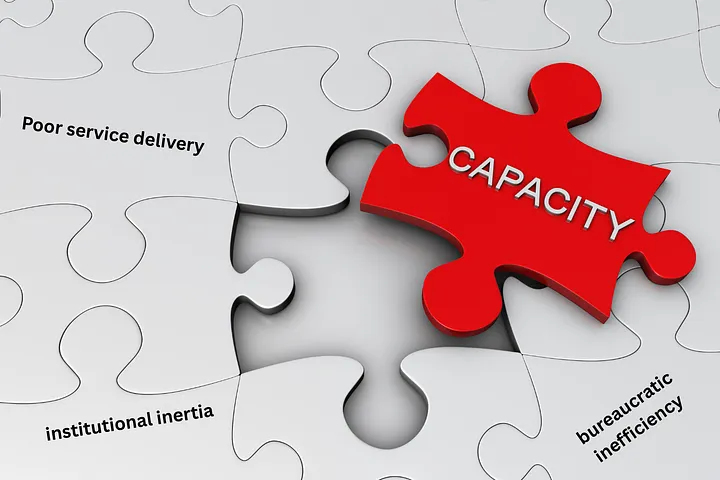
 

Capacity development isn’t just about training workshops or more degrees. It’s about cultivating responsive, adaptive, and future-ready public institutions.

Nigeria’s public service has long been burdened by structural and functional inefficiencies. While reform programs like SERVICOM and the National Strategy for Public Service Reform (NSPSR) have attempted to revamp service delivery, many of these efforts fall short due to:

1. Fragmented implementation

2. Poor alignment with actual skills needs

3. Lack of sustainability in training outcomes

As global governance standards evolve — driven by technology, transparency, and citizen demands — the urgency to equip public servants with the right tools and mindset becomes paramount.

What’s Really Missing?

 

Skills gap

Research shows that public institutions in Nigeria suffer from critical gaps in areas like:

  • Policy planning and execution
  • Data-driven decision-making
  • Performance monitoring and evaluation
  • Leadership and strategic thinking

But identifying what’s missing is just one side of the coin. The other is understanding how to fix it — contextually and sustainably.

Learning from Others: Global Lessons, Local Solutions

 

Kenya Huduma Centre Website (Source: https://arkafrica.com/work/kenya-huduma-digital-transformation/)

Countries like Kenya, Ghana, and South Africa have faced similar governance challenges. Yet, through deliberate capacity-building efforts, they’ve begun to turn the tide. Here are a few lessons Nigeria can draw from:

  • Kenya’s Huduma Centres: These one-stop government service shops improved citizen satisfaction through workforce retraining and digital integration.
  • Ghana’s Civil Service Training Centre Revamp: Focused on continuous professional development, especially in ICT and change management.
  • South Africa’s National School of Government: Introduced mandatory, career-based training to build competency pipelines within government roles.

These examples underscore a key point: reform isn’t a one-off project. it’s a systemic, ongoing process.

Toward a Smarter, Stronger Public Service

To continue reading… Visit https://publicsecgov.org/

Have thoughts on how Nigeria can reform its public service? Share in the comments or reach out to continue the conversation.


Share your thoughts

Zainab Ibrahim-Louisy

Head strategy & Transformation, National Credit Guarantee Company

We are pleased to introduce Zainab Ibrahim-Louisy, a seasoned finance and strategy leader with extensive experience spanning public finance, investment management, development finance, and sustainable investing.

She currently serves as Head, Strategy & Transformation at the National Credit Guarantee Company (NCGC), where she provides strategic leadership across enterprise transformation, performance management, institutional development, and strategic partnerships aligned with national economic priorities.

Zainab has held impactful roles at the Office of the Minister of State for Finance, Ministry of Finance Incorporated (MOFI), and NIRSAL Plc, contributing to investment mobilisation, portfolio optimisation, blended finance, ESG integration, and governance compliance.

Her earlier experience in the private sector, including roles at FBNQuest Merchant Bank and Kakawa Discount House, further strengthens her perspective across finance, investment, and institutional strategy.

A Certified PRINCE2 Project Manager and ESG & Impact Investing Expert, Zainab brings together strategic insight, analytical rigour, and a strong results-oriented approach.


Gwa Tobbie Mohammed

Director, Commission Secretariat, Nigerian Communications Commission (NCC)

Mr. Gwa Tobbie Mohammed is a Director, Commmision Secretariat with the Nigerian Communications Commission (NCC), where he has served since 2004.

A lawyer by training, he graduated from the University of Jos in 1990, was called to the Nigerian Bar in 1991, and obtained a Master of Laws degree in 2019. He is also a Certified Regulation Specialist, accredited by the Institute of Public-Private Partnership, Washington DC.

Before joining the Commission, Mr. Mohammed built extensive litigation experience and also worked as Legal Officer at Benue Cement Company, PLC, Gboko, where he was responsible for corporate compliance, community relations, and litigation.

In October 2020, the Governing Board of the Commission appointed him as Commission Secretary. He also served as a member of the Governing Board of the Digital Bridge Institute, Abuja, from July 2021 to May 2026.

Over the years, Mr. Mohammed has represented Nigeria as a subject-matter expert and country representative at various international fora, bringing valuable regulatory and institutional experience to the public sector governance space.

Mohammed Kadir Segun

Assistant Director, Technical Intelligence, National Drug Law Enforcement Agency (NDLEA)

Mohammed Kadir Segun is a public servant and currently an Assistant Director, Intelligence (Technical Intelligence) with the National Drug Law Enforcement Agency (NDLEA). Mohammed joined the NDLEA in 2001, and was commissioned the same year. He has served in various NDLEA Commands as a Narcotics Investigator and also served as an instructor at the Agency’s academy, Jos.

In 2014, he was selected as a member of Core-Team, a team constituted to ‘research, analyze and propose specifications for change to enable the NDLEA moved from a predominantly reactive to a proactive intelligence-led agency, a UN funded project NGAV 16 ‘Response to drug and related organized crime in Nigeria.

His contributions to the NDLEA’s strategic initiatives include the NDLEA Blueprint (2015), a comprehensive roadmap for enhancing the agency’s operational efficiency; the NDLEA National Threat Assessment (2017), a critical analysis of emerging drug threats and their implications to national security; the NDLEA Strategic Plan (2021-2025), a forward-looking strategy to guide the agency’s activities over the next five years; and Transnational Organise Crime (2027-2031), as a member of the National Working Group on Transnational Organise Crime in Nigeria.

Prof. Taiwo Afolabi

Founder and CEO, Emissary Group (EG)

Meet our keynote speaker, Prof. Taiwo Afolabi, PhD, C.Dir, ASC, FRSA, MRSC

An award-winning researcher, educator, entrepreneur, and Chartered Director, Prof. Taiwo Afolabi brings a wealth of global experience in board governance, executive leadership, strategic advising, and organisational development.

With professional experience spanning 35 countries across six continents, he has provided strategic leadership across higher education, creative technology, culture, and entertainment.

As Founder and CEO of Emissary Group, and through several international board appointments and leadership roles, Prof. Afolabi has contributed to strategic planning, governance, organisational transformation, leadership transitions, and sustainable growth.

He is a Canada Research Chair in Socially Engaged Theatre, a 3M National Teaching Fellow, and holds a PhD in Applied Theatre, alongside professional qualifications in board governance and business leadership.

The Honourable Kelechi (Kaycee) Madu, KC, ECA

Managing Lawyer, Kaycee Madu, KC Law firm

Former Deputy Premier, Attorney General, Minister of Justice and Solicitor General of Alberta, Kaycee Madu brings extensive experience in public leadership, governance, policy development, and board appointments.

Representing Edmonton-South West in the Legislative Assembly of Alberta from 2019 to 2023, he served across several key ministerial portfolios and multiple Cabinet Policy Committees, providing strategic oversight on issues spanning justice, public safety, labour, immigration, skilled trades, and municipal affairs.

As a Cabinet Minister, Madu was also responsible for making appointments to provincial boards, agencies, and quasi-judicial bodies, giving him first-hand experience of the importance of effective leadership and sound appointment processes in public institutions.

Kaycee Madu made history as Canada’s first Black Attorney General and Minister of Justice and Solicitor General, and its first Black Deputy Premier.

He is currently the Managing Lawyer of Kaycee Madu KC Law Firm, a full-service law firm in downtown Edmonton.

Bij lizaro casino kun je verschillende spellen en aanbiedingen bekijken voordat je een account aanmaakt.
Stuck choosing between free spins offers? a beginner's guide to betting stats helps you calculate expected value, so you can compare casino promotions with real numbers instead of hype.