

Governance Scorecards: Measuring What Truly Matters
Introduction
Governance scorecards have emerged as a central instrument for evaluating institutional accountability, board effectiveness, and strategic alignment in both public and private sector organisations. Yet critics increasingly argue that prevailing scorecard frameworks privilege compliance-based metrics over substantive governance outcomes. This article examines the conceptual foundations of governance scorecards, evaluates dominant international frameworks including those advanced by the Organisation for Economic Co-operation and Development (OECD), the World Bank, and the International Finance Corporation (IFC), and proposes a reorientation toward outcome-driven, culturally sensitive, and contextually adaptive measurement. The article argues that measuring what truly matters in governance requires a shift from procedural checklists to dynamic, stakeholder-inclusive systems of accountability.
Conceptual Foundations
What are governance scorecards?

A governance scorecard is a structured assessment tool that aggregates indicators of institutional conduct, policy adherence, board composition, and risk management into a comparative score or rating. Scorecards serve multiple functions: they signal credibility to capital markets, facilitate regulatory oversight, enable cross-jurisdictional benchmarking, and surface governance gaps for remediation (OECD, 2023).
The literature distinguishes between two primary typologies. Input-based scorecards evaluate governance structures, whether boards have independent directors, whether audit committees meet quarterly, whether codes of conduct exist. Outcome-based scorecards, by contrast, attempt to measure whether governance structures actually produce accountability, integrity, and long-term value creation (Bebchuk & Weisbach, 2010).
The Compliance Trap
The dominance of input-based frameworks reflects what Hess (2021) terms the “compliance trap” a tendency for institutions to optimise for measurable indicators rather than genuine behavioural change. In practice, organisations learn to perform well on scorecards without changing underlying decision-making cultures. The result is what Power (1997) memorably described as the “audit society” institutions preoccupied with the appearance of accountability rather than its substance.

The African Corporate Governance Network (ACGN) documented this phenomenon across fourteen jurisdictions in 2022, finding that companies with the highest corporate governance scores in their respective markets were not significantly less likely to experience fraud, related-party transaction abuses, or board entrenchment than lower-scoring peers (ACGN, 2022). Similar findings have emerged in research on EU-listed companies following the implementation of the Shareholder Rights Directive II (Sjafjell & Sjåfjell, 2021).
Dominant International Frameworks: A Critical Appraisal
The OECD Corporate Governance Framework
The OECD Principles of Corporate Governance, last revised in 2023, represent the most widely referenced global standard for governance assessment. The Principles address six thematic domains: the basis for an effective governance framework, the rights and equitable treatment of shareholders, institutional investors and markets, the role of stakeholders, disclosure and transparency, and board responsibilities (OECD, 2023).
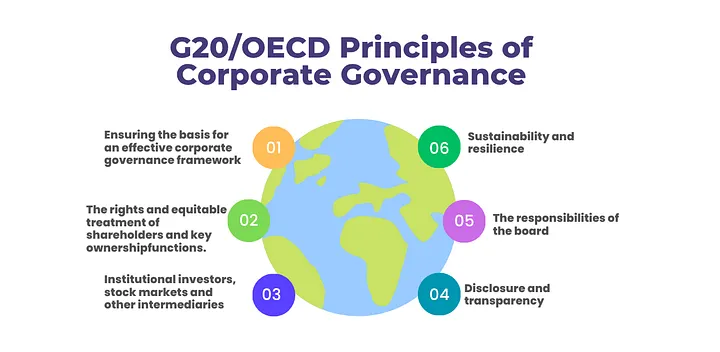
The OECD framework has considerable merit: it is jurisdictionally neutral, regularly updated, and grounded in comparative institutional analysis across 49 member and partner economies. However, its voluntary nature and its emphasis on disclosure rather than demonstrable impact limits its utility as an accountability mechanism in jurisdictions with weak enforcement capacity (Jesover & Kirkpatrick, 2005; OECD, 2023).
The World Bank Governance Indicators
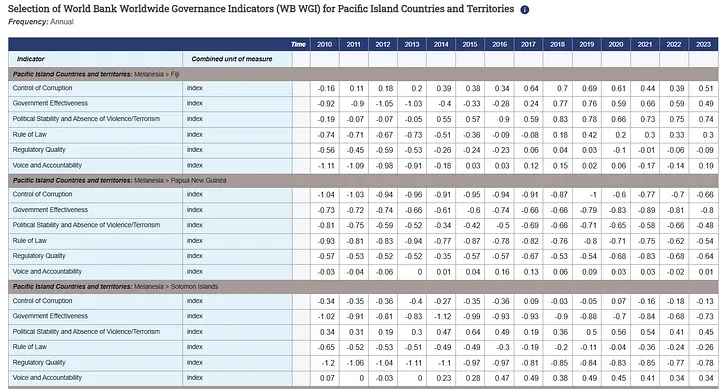
The World Bank’s Worldwide Governance Indicators (WGI) measure six dimensions of governance at the national level: voice and accountability, political stability, government effectiveness, regulatory quality, rule of law, and control of corruption (World Bank, 2023). These indicators are widely used by development financiers and sovereign credit rating agencies. However, methodological critiques have been persistent. Thomas (2010) and Langbein and Knack (2010) argued that WGI scores reflect perceptions more than objective institutional performance, and that the aggregation methodology obscures important within-country variation.
Governance Scorecards in Nigeria’s Public Sector
Administrative Compliance and Real Accountability
Nigeria’s public sector presents one of the clearest examples of the limitations of governance scorecards within state institutions. Across ministries, departments, agencies (MDAs), government-owned enterprises (GOEs), regulatory commissions, and development agencies, governance frameworks have expanded significantly over the past two decades. Yet measurable compliance has not consistently translated into institutional accountability, service delivery improvement, or public trust.
As Africa’s largest public administration system by scale, Nigeria has become a focal point for governance reform initiatives driven by international development institutions, fiscal reform programmes, and domestic accountability campaigns. Annual reporting templates, fiscal transparency scorecards, procurement assessments, anti-corruption compliance frameworks, and public financial management benchmarks are now widely used across the public sector.
However, the Nigerian experience demonstrates that the existence of governance metrics does not necessarily produce accountable governance outcomes.
The central challenge is not the absence of frameworks, policies, or scorecards. Rather, it is the persistent disconnect between formal administrative compliance and the realities of institutional performance, enforcement, and public accountability.
Institutional landscape
Nigeria’s public governance architecture operates through a highly centralised but fragmented institutional system spanning federal, state, and local government structures. Oversight responsibilities are distributed across institutions such as the Office of the Auditor-General for the Federation, the Bureau of Public Procurement (BPP), the Fiscal Responsibility Commission (FRC), the Independent Corrupt Practices Commission (ICPC), the Code of Conduct Bureau (CCB), the Public Accounts Committees of the National Assembly, and sector regulators.
Government-owned enterprises and public agencies are also subject to varying reporting requirements from supervising ministries, the Budget Office, the Office of the Accountant-General, and in some cases the Financial Reporting Council of Nigeria (FRCN). In recent years, reforms such as the Public Procurement Act, the Fiscal Responsibility Act, Treasury Single Account (TSA) policy, and performance-based budgeting initiatives have introduced more structured accountability mechanisms into the public sector.

On paper, these reforms suggest a steadily improving governance environment. Many agencies now publish strategic plans, procurement records, budget implementation reports, audited financial statements, and corporate governance disclosures. Some state-owned enterprises have also adopted governance frameworks modelled after private sector corporate governance codes.
However, the mere presence of reporting mechanisms often masks deeper governance weaknesses. Compliance frequently becomes procedural rather than substantive. Institutions may satisfy documentation requirements without meaningfully improving transparency, efficiency, or oversight effectiveness.
In practice, governance performance across Nigerian public institutions remains uneven, inconsistent, and heavily dependent on political leadership and institutional culture rather than formal scorecard systems alone.
Compliance illusion
A recurring feature of governance reforms in Nigeria’s public sector is the gap between reported compliance and actual institutional accountability. Numerous MDAs and government-owned enterprises formally comply with reporting obligations while still exhibiting weak procurement controls, opaque decision-making processes, poor project execution, and limited public disclosure.
Annual reports, where available, are often irregular, outdated, or inaccessible to the public despite formal reporting mandates. In many institutions, board composition is publicly undisclosed, committee structures remain unclear, and governance information is fragmented across multiple government platforms. Some agencies publish audited financial statements without broader operational or governance reporting, creating the appearance of compliance while limiting meaningful accountability assessment.

This pattern reflects a broader administrative culture in which governance reforms are sometimes treated as external compliance exercises rather than internal accountability commitments. Public institutions may adopt governance templates primarily to satisfy supervisory agencies, donor expectations, or legislative requirements without corresponding changes in institutional behaviour.
The reality is particularly visible in the management of government-owned enterprises. Several SOEs maintain formal boards, audit committees, procurement units, and reporting structures, yet continue to face persistent concerns relating to financial opacity, political interference, delayed reporting, and weak operational accountability. In some cases, institutions with satisfactory administrative compliance records have still experienced governance failures, leadership crises, or audit queries.
These realities expose the limitations of governance scorecards that focus heavily on procedural indicators while underestimating political influence, enforcement weakness, and institutional capacity constraints. A public institution may score positively on governance documentation while remaining ineffective in delivering transparency, accountability, or public value.
Structural Constraints Within the Nigerian Public Sector
The limitations of governance scorecards in Nigeria are rooted not only in implementation failures, but also in deeper structural features of the public sector environment.

First, political interference significantly shapes governance outcomes within public institutions. Leadership appointments in many agencies and SOEs are politically influenced, which can weaken board independence, oversight effectiveness, and administrative continuity. Governance structures may formally exist, yet operate with limited autonomy from political authorities. Under such conditions, scorecards measuring structural compliance cannot adequately capture the realities of institutional independence or decision-making integrity.
Second, enforcement institutions often face capacity limitations. Oversight bodies may lack sufficient funding, technical personnel, data systems, or prosecutorial authority to ensure consistent compliance across thousands of public institutions. Regulatory overlap between agencies can also create accountability gaps, duplication, and institutional ambiguity.
Third, transparency infrastructure remains uneven across the public sector. While some institutions maintain functional digital reporting systems and regularly publish governance information, many others lack updated websites, accessible records, or standardised reporting formats. As a result, public accountability frequently depends on institutional discretion rather than enforceable disclosure culture.
Fourth, governance assessment frameworks within the Nigerian public sector often prioritise administrative inputs over governance outcomes. The existence of policies, committees, and reporting templates is easier to measure than the quality of oversight, ethical conduct, procurement integrity, or service delivery performance. Consequently, governance scorecards may overstate institutional accountability while understating operational weaknesses.
Finally, civic oversight mechanisms remain limited. Public engagement with governance reporting is still relatively weak due to low accessibility of information, inconsistent data quality, and limited institutional responsiveness to public scrutiny. Governance systems function more effectively when reporting is linked to active oversight from citizens, civil society organisations, professional bodies, and the media.
Towards a More Contextual Public Sector Governance Framework
A governance assessment framework suited to Nigeria’s public sector realities would need to move beyond narrow administrative compliance metrics. Effective public sector governance assessment must account for institutional independence, enforcement quality, transparency accessibility, and operational accountability.
First, governance evaluation should differentiate between categories of public institutions. Ministries, regulatory agencies, development commissions, and commercial state-owned enterprises operate under different governance pressures and accountability expectations. Applying identical scorecard models across all institutions risks oversimplifying governance realities.
Second, public sector governance assessments should place stronger emphasis on disclosure accessibility and reporting consistency. The public availability of annual reports, board information, procurement disclosures, and audited statements should be treated as foundational accountability indicators rather than optional governance enhancements.
Third, governance scorecards should integrate outcome-based indicators alongside procedural metrics. The effectiveness of audit recommendations, procurement compliance outcomes, implementation rates of oversight findings, and responsiveness to public accountability mechanisms provide stronger indicators of governance quality than structural compliance alone.
Fourth, governance reform efforts must strengthen institutional enforcement capacity. Without credible consequences for non-compliance, governance scorecards risk becoming symbolic administrative exercises rather than tools of accountability.
Nigeria’s public sector governance trajectory remains complex but not static. Important reforms have been introduced, institutional awareness of governance standards has increased, and public expectations around transparency continue to grow. However, governance scorecards can only become meaningful where there is sustained commitment to institutional independence, enforcement credibility, transparency culture, and civic accountability.
The Nigerian experience ultimately demonstrates that governance cannot be reduced to reporting templates or compliance indicators alone. Real accountability depends not only on what institutions disclose, but on whether governance systems meaningfully constrain abuse of power, strengthen oversight, and improve public trust in state institutions.
References
African Corporate Governance Network (ACGN). (2022). Corporate governance scorecard outcomes and firm-level misconduct: Evidence from fourteen African markets. ACGN Research Paper №7. Nairobi: ACGN.
Bebchuk, L. A., & Weisbach, M. S. (2010). The state of corporate governance research. Review of Financial Studies, 23(3), 939–961. https://doi.org/10.1093/rfs/hhp121
DiMaggio, P. J., & Powell, W. W. (1983). The iron cage revisited: Institutional isomorphism and collective rationality in organizational fields. American Sociological Review, 48(2), 147–160. https://doi.org/10.2307/2095101
Financial Reporting Council (FRC). (2016). Corporate culture and the role of boards: Report of observations. London: FRC. https://www.frc.org.uk/culture
Financial Reporting Council (FRC). (2018). The UK Corporate Governance Code. London: FRC. https://www.frc.org.uk/directors/corporate-governance-and-stewardship/uk-corporate-governance-code
Freeman, R. E. (1984). Strategic management: A stakeholder approach. Boston: Pitman.
Global Reporting Initiative (GRI). (2021). GRI Universal Standards 2021. Amsterdam: GRI. https://www.globalreporting.org/standards/
Hess, D. (2021). The governance of corporate social responsibility: The compliance trap and institutional innovation. Business Ethics Quarterly, 31(4), 479–507. https://doi.org/10.1017/beq.2021.12
Institute of Directors in South Africa (IoDSA). (2016). King IV Report on Corporate Governance for South Africa. Johannesburg: IoDSA. https://www.iodsa.co.za/king-iv
International Corporate Governance Network (ICGN). (2021). ICGN Global Governance Principles (revised ed.). London: ICGN. https://www.icgn.org/policy/global-governance-principles
International Finance Corporation (IFC). (2019). IFC corporate governance methodology. Washington, DC: World Bank Group. https://www.ifc.org/corporategovernance
International Sustainability Standards Board (ISSB). (2023). IFRS S1 General requirements for disclosure of sustainability-related financial information. London: IFRS Foundation.
Jesover, F., & Kirkpatrick, G. (2005). The revised OECD principles of corporate governance and their relevance to non-OECD countries. Corporate Governance: An International Review, 13(2), 127–136. https://doi.org/10.1111/j.1467-8683.2005.00412.x
Johannesburg Stock Exchange (JSE). (2022). JSE Listings Requirements: Governance disclosure provisions (updated ed.). Johannesburg: JSE.
Kaufmann, D., & Kraay, A. (2022). Worldwide Governance Indicators: Methodology and analytical issues revisited. Policy Research Working Paper №10073. Washington, DC: World Bank.
Langbein, L., & Knack, S. (2010). The worldwide governance indicators: Six, one, or none? Journal of Development Studies, 46(2), 350–370. https://doi.org/10.1080/00220380902930350
Leblanc, R., & Gillies, J. (2005). Inside the boardroom: How boards really work and the coming revolution in corporate governance. Hoboken: Wiley.
Organisation for Economic Co-operation and Development (OECD). (2023). G20/OECD Principles of Corporate Governance (2023 ed.). Paris: OECD Publishing. https://doi.org/10.1787/ed750b30-en
Power, M. (1997). The audit society: Rituals of verification. Oxford: Oxford University Press.
Sjåfjell, B. (2021). Regulating boards for sustainability: The implications of Shareholder Rights Directive II. European Business Organization Law Review, 22(1), 1–28. https://doi.org/10.1007/s40804-020-00184-5
Solomon, J. (2020). Corporate governance and accountability (5th ed.). Chichester: Wiley.
Thomas, M. A. (2010). What do the worldwide governance indicators measure? European Journal of Development Research, 22(1), 31–54. https://doi.org/10.1057/ejdr.2009.32
World Bank. (2023). Worldwide Governance Indicators 2023 update: Overview and methodology. Washington, DC: World Bank. https://info.worldbank.org/governance/wgi/
Zondo, R. M. M. (2022). Judicial Commission of Inquiry into Allegations of State Capture, Corruption and Fraud in the Public Sector including Organs of State: Final Report (Parts I–VI). Johannesburg: Government Printer.